
What does full hookup mean? A full hookup campsite gives your RV electricity, fresh water, and a sewer connection right at your site. A partial hookup usually means water and electric only, and dry camping means no hookups at all. The right choice depends on how long you're staying, the weather, and how comfortable you are managing your RV's tanks and batteries. This guide compares all three and decodes the shorthand you'll see on campground listings.
The Bottom Line
- Full hookup (FHU): water, electric, and sewer at your site.
- Partial hookup: usually water and electric; you dump tanks at a dump station on the way out.
- Dry camping: no hookups — you run on your fresh tank, batteries, and generator.
- Weekend trips do fine on partial hookups; long stays and hot summers favor full hookups.
- 30-amp service supplies about 3,600 watts, so you can't run everything at once.
What does full hookup mean at an RV park?
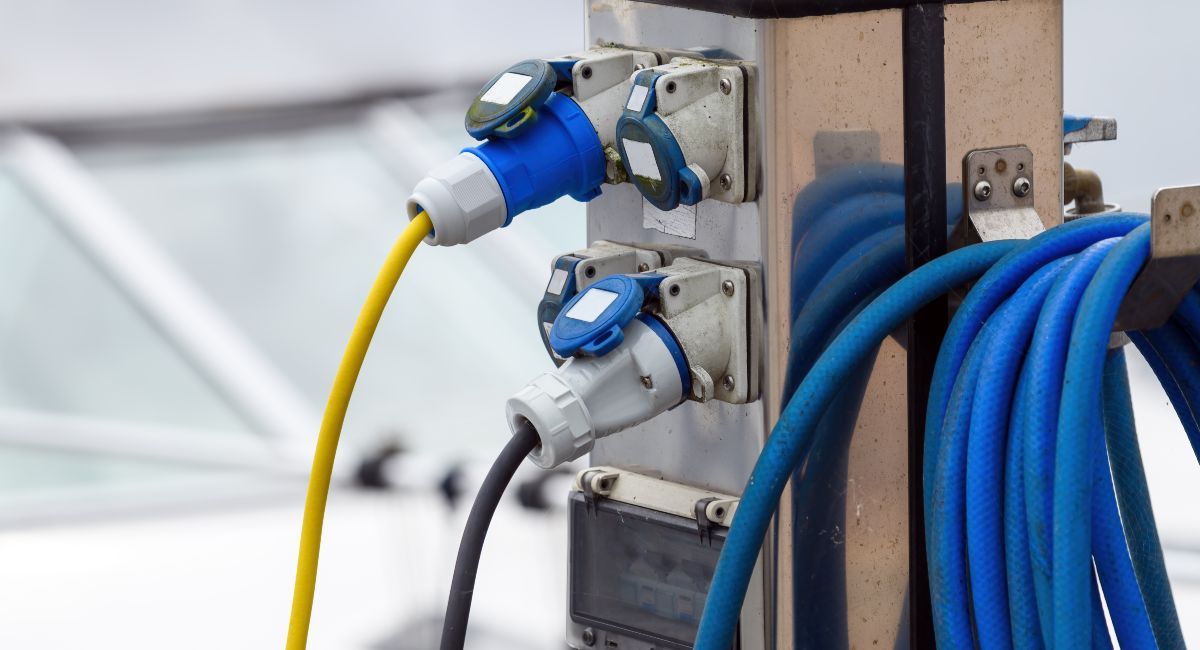
Full hookup means your campsite has all three connections: electricity, fresh water, and sewer. You plug into power, connect a drinking-water hose, and attach a sewer hose so your gray and black tanks drain directly. Full hookup sites usually offer 30-amp or 50-amp electric service.
KOA's guide to RV site types puts it plainly: "A full hookup lets you connect your RV directly to electricity, water and sewer." That's the most convenient setup — no watching tank levels, no dump station line on checkout morning. National parks often offer full hookups only at concessioner RV parks; at Big Bend, for example, the Rio Grande Village RV Campground has full hookups, while the park's other campgrounds don't.
New to connecting? Our guide on how to hook up and use an RV sewer hose walks through it — gloves on, and open the black tank valve first so the gray water rinses the hose. Nobody wants the surge of yuck.
What's the difference between full, partial, and dry camping?
Full hookup sites include water, electric, and sewer. Partial hookup sites usually include water and electric, but sometimes only electric. Dry camping sites have no hookups. The fewer the hookups, the lower the price tends to be — and the more you'll manage your own water, power, and waste.
- Full hookup (FHU) — Electric: Yes; Water: Yes; Sewer: Yes; You'll need to…: Just connect hoses; Typical cost: Higher end.
- Partial hookup (W/E) — Electric: Yes; Water: Yes (usually); Sewer: No; You'll need to…: Dump tanks at a dump station; Typical cost: Higher end.
- Electric only — Electric: Yes; Water: No; Sewer: No; You'll need to…: Fill fresh tank; dump at a station; Typical cost: Varies.
- Dry camping — Electric: No; Water: No; Sewer: No; You'll need to…: Use tanks, batteries, generator; Typical cost: Lower end.
Outdoorsy's RV park rates guide notes that RV park rates generally range from $20 to $100 a night, depending on location, amenities, and time of year. At national park campgrounds, dry camping spots typically sit at the lower end of that range, with partial and full hookup sites at the higher end.
Watch the terminology. KOA calls a power-only site a "dry hookup" — "a power source for your RV but no water or sewer connection." That's not the same as dry camping, which means no hookups at all. Read the listing details, not just the label.
National park campgrounds often fall in the middle. At Cumberland Gap's Wilderness Road Campground, some loops offer electric sites with no full hookups (no sewer or water at individual sites), plus a dump station near the entrance.
RVers we talk to who book partial hookups for weekends rarely miss the sewer. Two or three nights usually fit comfortably in a rental's tanks.
How do you read campground site codes?
Campground listings use shorthand: FHU means full hookup, W/E means water and electric, and 30A or 50A tells you the electrical service. Pull-through sites let you drive in and out without backing up, while back-in sites require reversing into place. Decode the listing before you book.
- FHU — Meaning: Full hookup — water, electric, sewer.
- W/E — Meaning: Water and electric (partial hookup).
- E — Meaning: Electric only.
- 30A / 50A — Meaning: 30-amp or 50-amp electrical service.
- Pull-through — Meaning: Drive in one end, out the other.
- Back-in — Meaning: Reverse into the site.
- Dump station — Meaning: Shared spot to empty tanks.
KOA describes a pull-through site as one that "lets you pull directly into your site," while back-in sites "feature a 60-degree or 90-degree slant, providing a wide clearance for you to back your rig up." First-time drivers often find pull-throughs worth any extra cost.
30-amp vs 50-amp: what can you run at once?
A 30-amp RV connection provides about 3,600 watts — roughly enough for one air conditioner plus a few small appliances. A 50-amp connection provides about 12,000 watts across two 120-volt legs, enough to run two air conditioners and more. Larger RVs usually have 50-amp systems; smaller rigs usually have 30-amp.
The National RV Training Academy does the math: "30 amps x 120 volts = 3,600 watts," while a 50-amp service delivers "6,000 watts per leg" for a "Total power: 12,000 watts." RV Education 101's Mark Polk notes that RVs with 50-amp service have a 4-prong power cord plug; 30-amp RVs use a 3-prong plug instead. Outdoorsy's RV electricity basics adds that larger RVs tend to have 50-amp systems.
The plugs are different hardware. A standard 30-amp RV receptacle is Leviton's 30 Amp, 125 Volt TT-30R "(For Recreational Vehicles)," a 2-pole, 3-wire design that matches the 3-prong plug, while 50-amp pedestals use the NEMA 14-50R, a 125/250-volt receptacle. You can plug a 30-amp RV into a 50-amp pedestal with an adapter, but as RV electrical educator Mike Sokol explains, power "will still be limited to 30 amps total" because your RV has a 30-amp main breaker.
In our experience, the A/C-plus-microwave breaker trip is the most common first-night surprise on a 30-amp site. Run big appliances one at a time.
How long can a rental RV last without hookups?
Many rental RVs can last about two to four days without hookups, depending on tank sizes, battery capacity, and how carefully you use water and power. The gray tank often fills first. Check your listing's fresh, gray, and black tank sizes, and plan to refill and dump before you run out.
That range is our editorial estimate for typical rentals, not a rule. Two people taking quick showers and washing dishes in a basin stretch tanks much further than a family of five. Fill up before you arrive — our guide on how to fill your RV's fresh water tank explains how — and learn the right way to dump with our black tank do's and don'ts.
For longer stays without hookups, see our guide to boondocking and free camping.
Which type of site should you book for your trip?
Book partial hookups for weekend trips, full hookups for week-long stays or hot weather, and dry camping when scenery or solitude matter more than convenience. National parks often mean partial or dry camping, with full hookups mostly at concessioner or private parks nearby.
Weekend getaway
A water-and-electric site covers two or three nights easily. Dump on the way out. We've watched renters pay for full hookups they didn't need on a two-night trip.
Week-long stay
Full hookups save you from mid-trip dump runs and let you shower without counting gallons.
Summer heat
If you'll run the A/C all day, book a 50-amp site for a big rig, or at least confirm your site's amperage matches your RV.
National park trip
Many park campgrounds have limited or no hookups. Book early, or stay at a full-hookup park just outside the gates. Hosts tell us renters who match the site type to the trip length have the smoothest stays.
Ready to pick your perfect site? Browse RV rentals near you and check each rig's tank sizes and amperage before you book. Find what moves you.
About this guide
This guide was researched and written by the Outdoorsy editorial team. Our information draws on KOA's site-type definitions, National Park Service campground pages for Big Bend and Cumberland Gap, electrical specifications from Leviton, the National RV Training Academy, RV Education 101, and RV electrical educator Mike Sokol, Outdoorsy's RV park rates and electricity guides, and conversations with Outdoorsy hosts and renters. We have no commercial relationship with the businesses mentioned unless explicitly noted.